Today · Jun 15, 2026
New 10% Tariffs Hit Your FF&E Supply Chain. The PIP You Budgeted Last Quarter Just Got Repriced.

New 10% Tariffs Hit Your FF&E Supply Chain. The PIP You Budgeted Last Quarter Just Got Repriced.

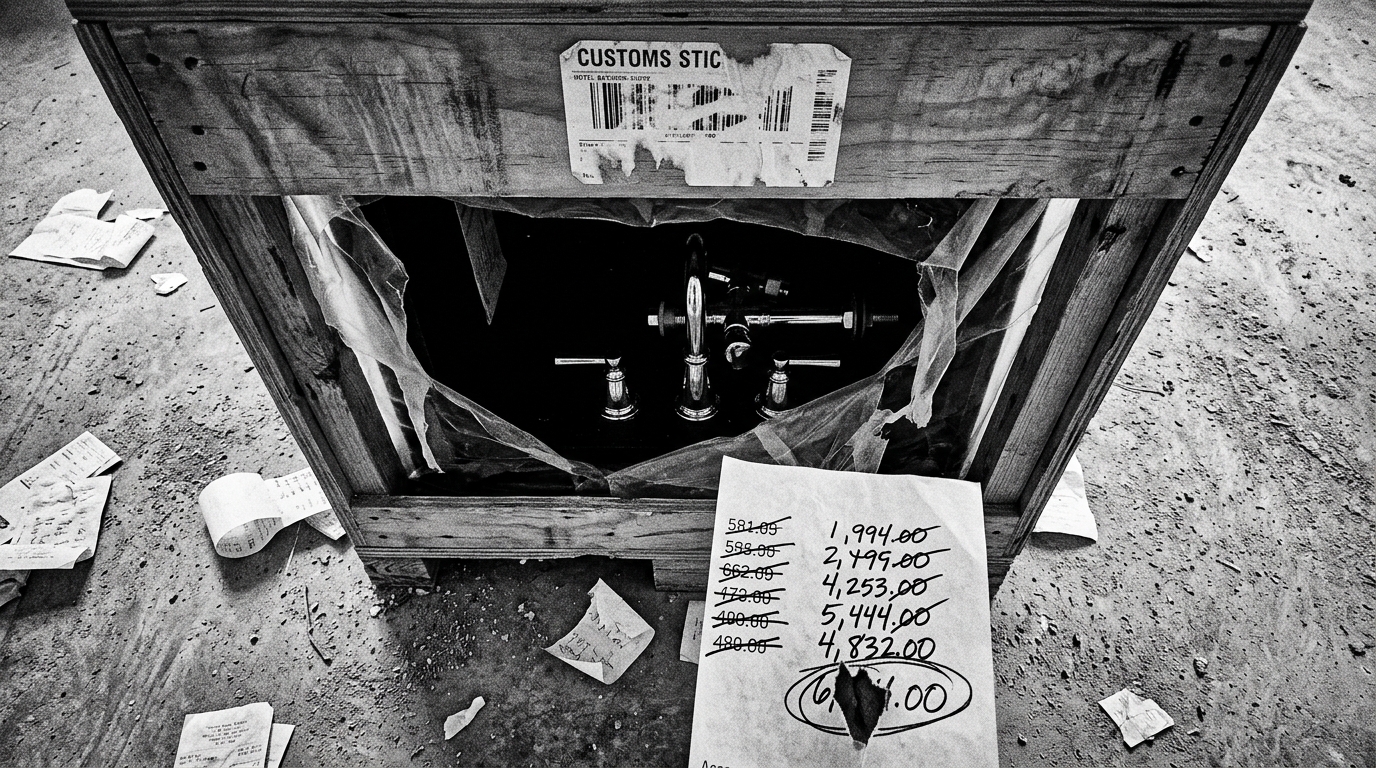
Proposed 10%–12.5% tariffs on imports from 60 economies, including Canada, the EU, and Mexico, land directly on the materials hotels use for renovations, linens, and amenities. The comment period closes July 6, and the owners who aren't modeling the cost impact right now are the ones who'll absorb it later.

Available Analysis

A 10% tariff on Canadian imports, stacked on top of a 6.8% year-over-year increase in nonresidential construction costs through Q1 2026, is not a trade policy story. It's a per-key renovation cost story. And the per-key number just moved.

Let's decompose this. The USTR's proposed Section 301 tariffs cover 60 economies at either 10% or 12.5%. Canada, Mexico, the EU, the UK, and Taiwan fall in the 10% tier. China, India, Vietnam, Japan, South Korea, and 40 others get 12.5%. The stated rationale is forced labor enforcement failures, but the mechanism is simple: imported goods cost more. For hotels, "imported goods" means Canadian lumber and millwork in your case goods, European textiles in your linens and bath amenities, Mexican-manufactured furniture, and Vietnamese soft goods. That's not a corner of your procurement. That's the center of it.

There's a CUSMA exemption for goods compliant with the U.S.-Canada-Mexico trade agreement, which matters. But compliance is product-specific and documentation-heavy. An FF&E vendor sourcing partially from Mexico doesn't automatically qualify. The exemption requires proof of origin at the line-item level, and most hotel procurement contracts don't specify origin with that precision. If your vendor can't certify CUSMA compliance by item, you're paying the tariff. The burden of proof isn't on customs. It's on the importer... which, depending on your contract structure, might be you.

Here's the timing problem. The comment period closes July 6. The public hearing is July 7. AHLA has stated that easing tariffs on hotel construction and renovation materials is a 2026 priority, and they're right to push it. But "priority" and "outcome" are different words. If these tariffs finalize as proposed, any PIP or renovation budgeted before June 2026 is working from a stale cost basis. I've seen portfolios where a 10% FF&E cost increase on a $4M renovation pushes the payback period from 7 years to 9. On a 10-year franchise agreement, that's the difference between a project that builds equity and one that barely breaks even (and that's before you account for the disruption cost that never makes it into the pro forma).

AHLA reported in Q1 2026 that GOPPAR is still running at roughly 90% of 2019 levels, with rising operating expenses as the primary drag. These tariffs don't help. They stack. Earlier Section 232 duties already inflated steel, aluminum, and copper pricing. This round adds another layer on a different set of inputs. For owners carrying renovation debt or approaching a PIP deadline, the math is getting harder in a specific, quantifiable way. The question isn't whether costs go up. It's whether the revenue premium from the renovation still justifies the capital at the new cost basis. For some properties, it won't.

Operator's Take

Here's what I'd do this week if I had a renovation or PIP anywhere in my pipeline for the next 18 months. First... call your FF&E vendor and ask two questions: what percentage of your materials originate from the 60 named economies, and can you certify CUSMA compliance at the line-item level? If they can't answer both clearly, you don't have a locked cost... you have an estimate that's about to move. Second... rerun your renovation pro forma with a 10% increase on imported FF&E components and see what it does to your payback period. If the project was already marginal, this is the moment to have that conversation with your owner... not after the tariffs finalize. Third... the comment period closes July 6. That's not decoration. AHLA and AAHOA are filing comments, and if your property has significant import exposure on a current project, adding your voice to the record is 30 minutes of work that might matter. Operators who bring this to their owners first, with the updated math already done, are the ones who look like they're running the business. The ones who wait get surprised.
— Mike Storm, Founder & Editor
Read full analysis → ← Show less
Source: Whitecase
Your 2026 PIP Budget Is Already Wrong. Tariffs Added 10-15% and Nobody Updated the Spreadsheet.

Your 2026 PIP Budget Is Already Wrong. Tariffs Added 10-15% and Nobody Updated the Spreadsheet.

The effective U.S. tariff rate just hit levels not seen since the 1940s, and the majority of hotel FF&E is manufactured in the countries getting hit hardest. If you're an owner with a renovation bid older than six months, the number on that proposal no longer reflects reality.

Available Analysis

A 10-15% increase in FF&E costs on a $4M PIP is $400K-$600K of unbudgeted capital. That's the finding. Everything else is context.

The effective U.S. tariff rate is somewhere between 11.8% and 15.8% depending on whose estimate you trust (J.P. Morgan says 15.8% as of mid-April; the source article says 11.8%; the Tax Foundation had 7.7% in 2025). The precise number matters less than the direction. It was 2.3% at the end of 2024. Section 232 tariffs now apply to the full customs value of imported goods containing steel, aluminum, and copper... not just the metal content. For casegoods, lighting, plumbing fixtures, bathroom vanities, that's a structural repricing. A 25% tariff on upholstered furniture hit in October 2025. Vanities and cabinets face planned increases to 50%, postponed to 2027 but already priced into vendor hedging. Vietnam, which absorbed a significant share of FF&E production as sourcing shifted away from China, now sits at a 20% tariff rate under the July 2025 trade deal (up from 3.3%). The diversification play that owners thought protected them... didn't.

I've seen this structure before in my audit years. An owner underwrites a renovation at one cost basis, signs a franchise agreement with a PIP timeline attached, and by the time procurement starts the assumptions are stale. The franchise agreement doesn't care that tariffs moved. The PIP deadline doesn't adjust for macroeconomic shifts. The owner absorbs the variance. RW Baird's analyst pegged the increase at 5-10% on total hard costs, noting that internationally sourced materials represent 15-20% of a typical project budget. Layer tariff contingency language that contractors are now embedding into new bids, and the owner who signed a fixed-price agreement six months ago is about to get a change order that turns a viable renovation into a marginal one. Select-service developers operating on tight per-key budgets feel this first. A project underwritten at $85K per key that now costs $93K per key is a different deal. The return profile shifted. The debt coverage shifted. The equity check got bigger.

The counterargument is supply constraint. If tariffs suppress new development by making construction more expensive, existing owners in supply-limited markets see less competitive pressure over 24-36 months. That's real. But it's a portfolio-level observation, not a property-level solution. The owner staring at a $4.6M renovation that was budgeted at $4M doesn't care about theoretical supply reduction in 2028. That owner needs $600K right now or needs to cut scope... and cutting scope on a brand-mandated PIP means negotiating with a franchisor who has limited incentive to compromise (the franchise fee doesn't decline when the renovation gets cheaper).

The owners who come out of this intact will be the ones who repriced their projects this month, not next quarter. Every FF&E procurement contract signed before Q4 2025 should be stress-tested against current tariff schedules. Every PIP timeline should be evaluated for acceleration (buying materials now at today's cost) or deferral (if the franchise agreement permits it). The math on "buy now versus wait" depends on whether you believe tariffs are going higher or stabilizing. Given that USTR just initiated Section 301 investigations into 16 additional economies including every major FF&E source country... I'd price in further escalation. Check again.

Operator's Take

Here's what to do this week. If you have a PIP due in 2026 or 2027, pull your most recent procurement bid and compare it against current landed costs for your top five FF&E line items... casegoods, soft goods, lighting, plumbing, decorative. If that bid is more than 90 days old, it's stale. Get a refreshed quote and run the variance against your approved CapEx budget. If the gap is more than 5%, you need to be in front of your ownership group with three options: accelerate procurement to lock current pricing, negotiate PIP scope with your brand (get it in writing), or resize the equity commitment. Don't wait for the brand to bring this up. Don't wait for your asset manager to ask. The operator who shows up with the problem AND three solutions is the one who keeps the trust. This is what I call the Renovation Reality Multiplier... the real cost of a renovation is never the number on the original bid. It's the number after reality gets involved. And reality just got 10-15% more expensive.

— Mike Storm, Founder & Editor
Read full analysis → ← Show less
Source: InnBrief Analysis — National News
Holiday Inn's "New Playbook" Is the Same Old Song With Better Staging

Holiday Inn's "New Playbook" Is the Same Old Song With Better Staging

IHG is dressing up Holiday Inn's refresh as a strategic revolution, but when you strip away the lobby renderings and the press-friendly language, the real question is whether owners will see returns that justify the capital... or just another round of brand theater with a nicer font.

Available Analysis

So IHG had a monster 2025. Record openings, 443 hotels, over 65,000 rooms added, operating profits up 15% to $1.2 billion, and a shiny new $950 million share buyback announced for 2026. The pipeline is 340,000 rooms deep. The fee margin expanded 360 basis points. If you're an IHG shareholder, you're having a wonderful year. If you're an IHG franchise owner staring down a property improvement plan tied to this "new playbook"... your year is about to get more complicated. And more expensive. And nobody at headquarters is going to sit across the table from you when the math doesn't work.

Let's talk about what this "playbook" actually is when you peel the press release off it. IHG has been pushing hard on conversions... roughly 60% of their openings and 40% of organic signings were conversions in early 2025. That tells you something important about the growth strategy: they're not building new hotels, they're rebadging existing ones. Which means they need a product model that's conversion-friendly, cost-efficient, and visually compelling enough to justify the flag change. Enter Holiday Inn Express 5.0, the "Dawn" model, with its emphasis on "space design, service details, and smart experiences." (That last phrase, "smart experiences," is doing a LOT of heavy lifting and I'd love for someone to define it in a sentence that an actual front desk agent could execute.) The per-room construction cost target of roughly $20,000 is a China-specific number, by the way. If you're an owner in Memphis or Boise expecting that figure to translate, I'd encourage you to sit down first.

Here's the part that makes my filing cabinet twitch. IHG's Americas RevPAR was up just 0.3% for the full year and actually declined 2% in Q4 2025... underperforming both Hilton and Marriott. So the domestic engine is cooling. And into that cooling environment, IHG is asking owners to invest capital in a refreshed product standard while simultaneously pushing conversion-heavy growth that dilutes the existing system's pricing power. You know what that looks like from the owner's chair? It looks like you're spending money to maintain a brand premium that's shrinking. I sat in a franchise review once where the brand rep kept talking about "the halo effect of system growth" and the owner next to me leaned over and whispered, "The halo is costing me $4,200 a month in fees and I can't tell you what it's doing for my rate." That owner wasn't wrong. And there are a lot of owners feeling exactly that way right now.

The FIFA World Cup narrative is interesting... IHG's CEO is publicly citing it as a 2026 demand catalyst, and he's probably right that select markets will see a lift. But "the World Cup will help" is not a brand strategy. It's a weather event. What happens in 2027 when the tournament is over and your PIP payments are still due? The Deliverable Test on this refresh is the same one I apply to every brand evolution: can the team at a 140-key Holiday Inn Express in a secondary market, staffed the way hotels are actually staffed right now (which is to say, thinly), deliver whatever "elevated experience" this playbook promises? Because if the answer requires a dedicated team member, a specialized amenity, or a technology integration that assumes broadband speeds your 1990s-era building can't support... you don't have a playbook. You have a fantasy document with a timeline attached.

I want to be clear... I'm not anti-IHG, and I'm not anti-refresh. Holiday Inn is one of the most recognized names in hospitality and it SHOULD evolve. But evolution that primarily serves the franchisor's fee margin (up 360 basis points, remember?) while the franchisee's RevPAR in the Americas barely moved? That's not a partnership. That's a subscription. And owners need to read the actual FDD, compare the projected loyalty contribution to what properties in their comp set are actually receiving, and make the decision with their calculator, not with the brand's slide deck. The slide deck always looks beautiful. The P&L is where the truth lives.

Operator's Take

If you're a Holiday Inn or HI Express franchisee getting the call about this refresh... before you agree to anything, pull your actual loyalty contribution numbers for the last 24 months and compare them to what was projected when you signed. Then ask your franchise rep to show you the same comparison for properties in your comp set. If they can't or won't provide it, that tells you everything you need to know. The shiny new playbook means nothing if the math underneath it hasn't changed. Get the math first. Decide second.

— Mike Storm, Founder & Editor
Read full analysis → ← Show less
Source: Google News: IHG
End of Stories