Your 2026 PIP Budget Is Already Wrong. Tariffs Added 10-15% and Nobody Updated the Spreadsheet.
The effective U.S. tariff rate just hit levels not seen since the 1940s, and the majority of hotel FF&E is manufactured in the countries getting hit hardest. If you're an owner with a renovation bid older than six months, the number on that proposal no longer reflects reality.
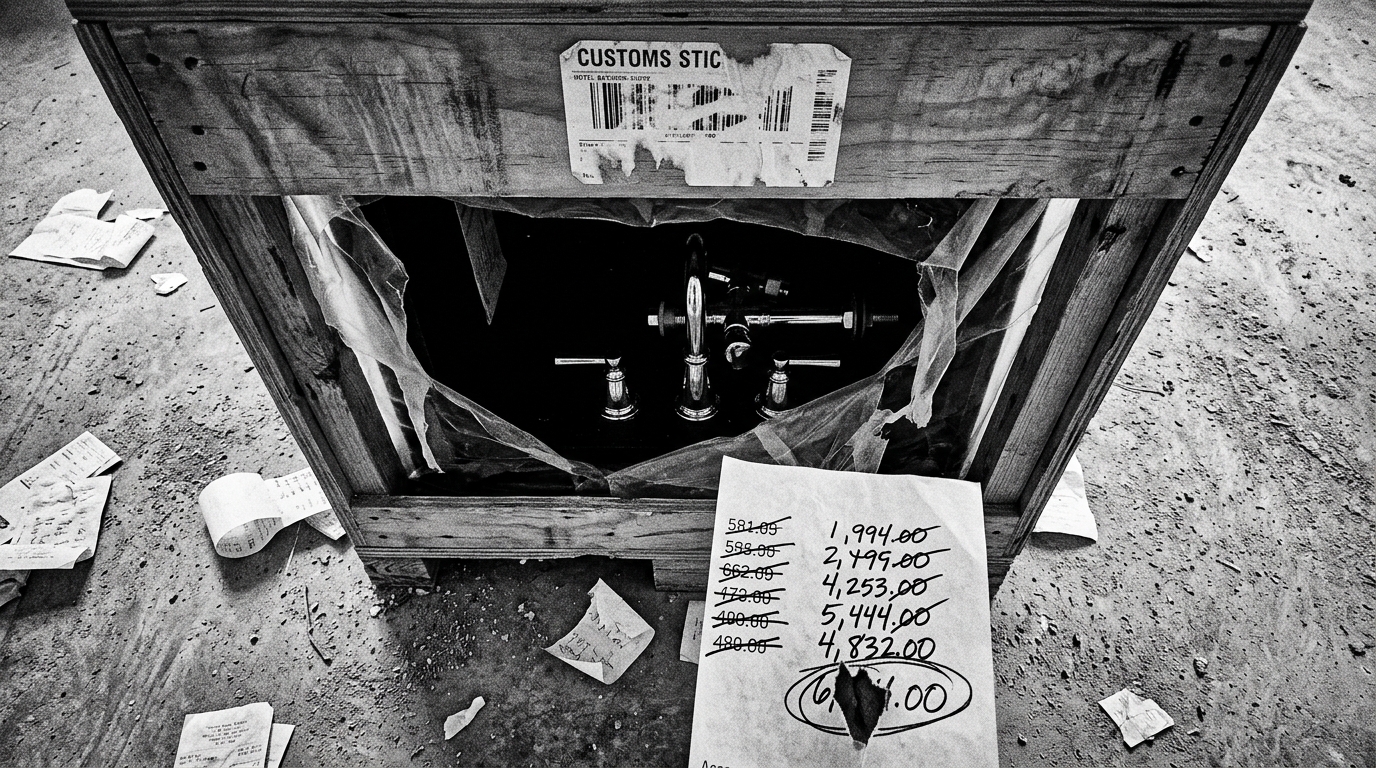
A 10-15% increase in FF&E costs on a $4M PIP is $400K-$600K of unbudgeted capital. That's the finding. Everything else is context.
The effective U.S. tariff rate is somewhere between 11.8% and 15.8% depending on whose estimate you trust (J.P. Morgan says 15.8% as of mid-April; the source article says 11.8%; the Tax Foundation had 7.7% in 2025). The precise number matters less than the direction. It was 2.3% at the end of 2024. Section 232 tariffs now apply to the full customs value of imported goods containing steel, aluminum, and copper... not just the metal content. For casegoods, lighting, plumbing fixtures, bathroom vanities, that's a structural repricing. A 25% tariff on upholstered furniture hit in October 2025. Vanities and cabinets face planned increases to 50%, postponed to 2027 but already priced into vendor hedging. Vietnam, which absorbed a significant share of FF&E production as sourcing shifted away from China, now sits at a 20% tariff rate under the July 2025 trade deal (up from 3.3%). The diversification play that owners thought protected them... didn't.
I've seen this structure before in my audit years. An owner underwrites a renovation at one cost basis, signs a franchise agreement with a PIP timeline attached, and by the time procurement starts the assumptions are stale. The franchise agreement doesn't care that tariffs moved. The PIP deadline doesn't adjust for macroeconomic shifts. The owner absorbs the variance. RW Baird's analyst pegged the increase at 5-10% on total hard costs, noting that internationally sourced materials represent 15-20% of a typical project budget. Layer tariff contingency language that contractors are now embedding into new bids, and the owner who signed a fixed-price agreement six months ago is about to get a change order that turns a viable renovation into a marginal one. Select-service developers operating on tight per-key budgets feel this first. A project underwritten at $85K per key that now costs $93K per key is a different deal. The return profile shifted. The debt coverage shifted. The equity check got bigger.
The counterargument is supply constraint. If tariffs suppress new development by making construction more expensive, existing owners in supply-limited markets see less competitive pressure over 24-36 months. That's real. But it's a portfolio-level observation, not a property-level solution. The owner staring at a $4.6M renovation that was budgeted at $4M doesn't care about theoretical supply reduction in 2028. That owner needs $600K right now or needs to cut scope... and cutting scope on a brand-mandated PIP means negotiating with a franchisor who has limited incentive to compromise (the franchise fee doesn't decline when the renovation gets cheaper).
The owners who come out of this intact will be the ones who repriced their projects this month, not next quarter. Every FF&E procurement contract signed before Q4 2025 should be stress-tested against current tariff schedules. Every PIP timeline should be evaluated for acceleration (buying materials now at today's cost) or deferral (if the franchise agreement permits it). The math on "buy now versus wait" depends on whether you believe tariffs are going higher or stabilizing. Given that USTR just initiated Section 301 investigations into 16 additional economies including every major FF&E source country... I'd price in further escalation. Check again.
Here's what to do this week. If you have a PIP due in 2026 or 2027, pull your most recent procurement bid and compare it against current landed costs for your top five FF&E line items... casegoods, soft goods, lighting, plumbing, decorative. If that bid is more than 90 days old, it's stale. Get a refreshed quote and run the variance against your approved CapEx budget. If the gap is more than 5%, you need to be in front of your ownership group with three options: accelerate procurement to lock current pricing, negotiate PIP scope with your brand (get it in writing), or resize the equity commitment. Don't wait for the brand to bring this up. Don't wait for your asset manager to ask. The operator who shows up with the problem AND three solutions is the one who keeps the trust. This is what I call the Renovation Reality Multiplier... the real cost of a renovation is never the number on the original bid. It's the number after reality gets involved. And reality just got 10-15% more expensive.