
Today · Apr 5, 2026
Your Hotel Restaurant Isn't Broken. Your Expectations Are.

Your Hotel Restaurant Isn't Broken. Your Expectations Are.

Everyone's suddenly rediscovering that hotel F&B can make money. The truth is it always could... if you stopped treating the kitchen like a checkbox and started running it like a business.

I sat across from an owner once... full-service, 280 keys, decent market... and he told me his restaurant was "a necessary evil." Those were his exact words. Necessary evil. The restaurant was doing $1.8 million in revenue with a 14% profit margin, and he was treating it like a tumor he couldn't remove. Meanwhile, his rooms department was celebrating a 3% RevPAR bump like they'd discovered fire. I pulled out a napkin and did the math right there. His "necessary evil" was generating more incremental profit opportunity per square foot than his lobby gift shop, his meeting space, and his vending operation combined. He just never looked at it that way because nobody had ever told him to.

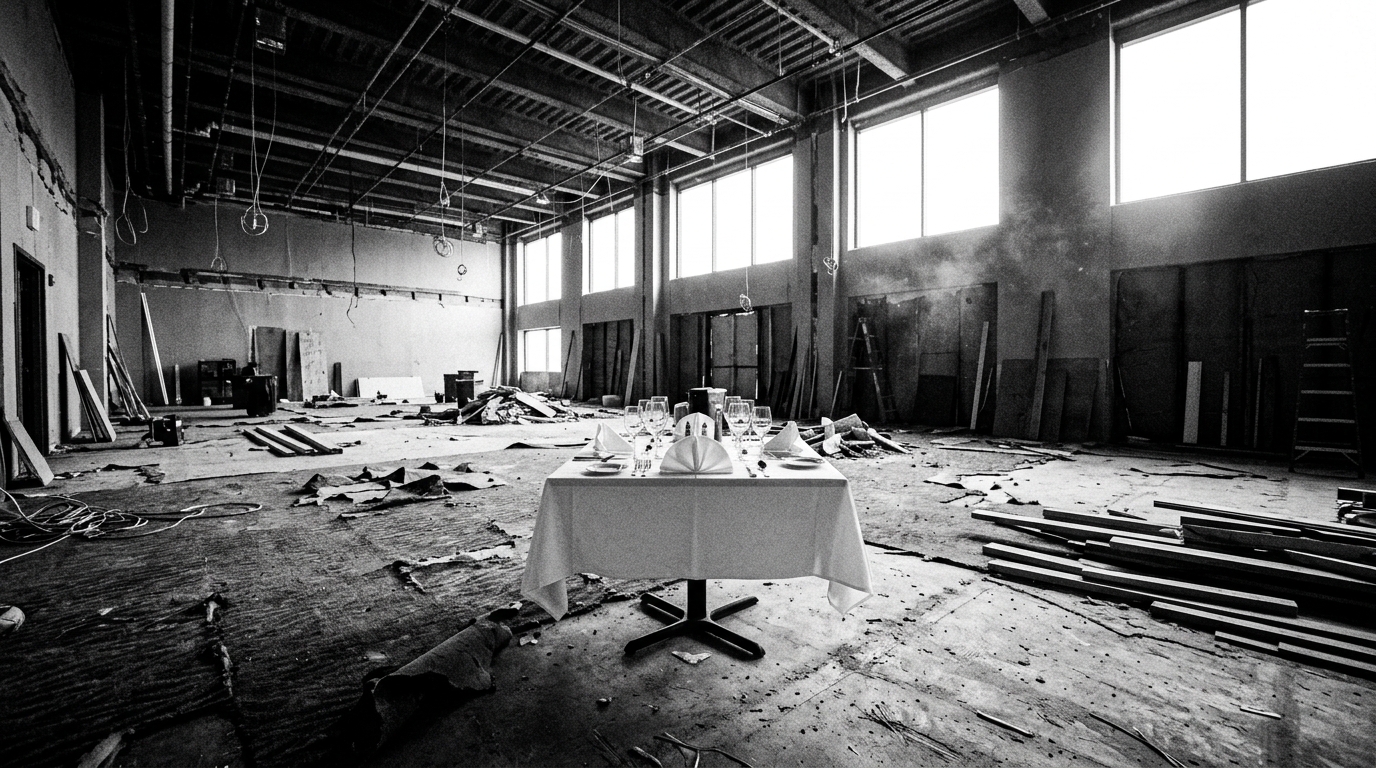
That's the hard truth about hotel restaurants. It's not that they lose money. Some do, sure. But the bigger problem is that we've spent 30 years telling ourselves they're supposed to lose money, and then we manage them accordingly. Self-fulfilling prophecy. You staff the kitchen like an afterthought, you hire an F&B director who's really just a banquet manager with a bigger title, you let the brand dictate a menu concept designed in a test kitchen 1,200 miles from your market... and then you're shocked when the P&L looks ugly. The restaurant didn't fail. You set it up to fail.

Look at the numbers that are actually coming in. F&B department profit margins hit 29.1% in the first half of 2025. F&B revenue per occupied room grew 3.8% while total hotel revenue grew 3.0%. That's F&B outpacing rooms. And rooms revenue growth is flattening... up only 0.8% in the first half of 2025. So if you're a GM still building your entire commercial strategy around RevPAR while your restaurant sits there generating 20-45% of total property revenue and you're not optimizing it... you're ignoring the fastest-growing line on your P&L. That's not strategy. That's habit.

Here's where it gets interesting (and where most of the industry commentary misses the point). The shift from RevPAR thinking to TRevPAR thinking isn't just a metric change. It's an operational philosophy change. When you manage for TRevPAR, suddenly that 2,400 square feet of restaurant space has to justify itself per square foot, just like your meeting rooms, just like your lobby bar. And when you start measuring revenue per square foot, you start making different decisions. You rethink the buffet that requires 14 chafing dishes and three attendants for a $22 breakfast. You look at that underperforming lunch service running Tuesday through Saturday for 11 covers a day and you ask whether a grab-and-go concept with a quarter of the labor would generate better margin. You stop copying the brand playbook and start reading your own data. CBRE says every 1% improvement in F&B profitability adds roughly $136,000 in hotel value for a typical full-service property. One percent. That's not a renovation. That's not a capital project. That's better purchasing, tighter scheduling, and a menu that actually reflects what your guests order instead of what your chef wants to cook.

The operators who are winning at F&B right now aren't the ones with celebrity chefs and $40 cocktails (though some of those work too). They're the ones who stopped treating the restaurant as an amenity and started treating it as a business unit with its own P&L accountability, its own marketing, and its own reason to exist beyond "the brand requires it." They're pulling locals in. They're running food cost at 28% instead of 35% because someone's actually counting inventory twice a week instead of once a month. They're cross-training staff so the breakfast server can cover the bar during the gap between lunch and dinner instead of scheduling a separate shift. It's not glamorous. It's not a press release. It's just good operations applied to a part of the building that's been neglected for a generation.

Operator's Take

This is what I call the Flow-Through Truth Test. Your F&B revenue can grow all day, but if the margin isn't flowing to GOP because you're overstaffed, over-concepted, or buying product like you're feeding a cruise ship, the top line is a vanity number. Here's what to do this week: pull your F&B P&L for the last six months, calculate your profit per square foot of restaurant space, and compare it to your meeting room revenue per square foot. If the meeting space wins by more than 30%, your restaurant has an operations problem, not a concept problem. If you're a GM at a full-service property reporting to a management company, bring that number to your next owner call. It changes the conversation from "should we even have a restaurant" to "how do we fix the one we've got." That's a better conversation.
Read full analysis → ← Show less
Source: Google News: CoStar Hotels
A $1M Restaurant Inside a $25M Bet on a Foreclosed Marriott

A $1M Restaurant Inside a $25M Bet on a Foreclosed Marriott

Visions Hotels bought a struggling 356-key full-service Marriott out of foreclosure for $14.4 million and is now pouring up to $25 million into renovations... nearly double the purchase price. The new restaurant getting all the press is just the tip of a very expensive iceberg.

Let me tell you the part of this story that the headline doesn't tell you.

Somebody bought a 356-room full-service Marriott at a post-foreclosure auction in 2023 for $14.4 million. That's roughly $40,400 per key for a full-service branded hotel. If that number doesn't make you sit up straight, you haven't been paying attention. That's select-service pricing for a full-service asset. Which tells you exactly how distressed this property was. The previous ownership couldn't make it work. The debt got called. The hotel went to auction. And Visions Hotels, a company out of Corning, New York that runs 50-plus properties, raised their hand and said "we'll take it."

Now they're spending $15 million to $25 million on renovations. All 356 rooms. Banquet facilities. And this new restaurant that's getting the headlines. Let's do the math that matters. At the high end, you're looking at $25 million in renovations on top of a $14.4 million acquisition. That's $39.4 million all-in, or about $110,700 per key. For a suburban Marriott on Millersport Highway in Amherst. That's a very different number than $40K per key, and it tells a very different story. This isn't a bargain flip. This is a ground-up repositioning bet disguised as a renovation. The restaurant is the part that photographs well for the press release. The real story is whether the market supports $110K per key in total basis.

I managed a property years ago that went through a similar cycle. Previous owner let it slide, brand got nervous, the debt went bad, new buyer came in with big plans and a thick checkbook. The renovation was beautiful. Genuinely impressive work. But nobody stress-tested whether the market had moved on during the years of neglect. The comp set had shifted. Corporate accounts had relocated their preferred hotel. Group business had found other venues. The building looked great. The revenue took three years to catch up to the new cost basis. Three years of an ownership group looking at monthly financials and wondering when "the turnaround" was going to show up in the numbers.

Here's what I think Visions Hotels is actually doing, and it's not stupid. They're betting that a full-service Marriott in that market, properly capitalized and properly run, has a revenue ceiling significantly higher than where the previous ownership was operating. They're probably right. A neglected full-service hotel bleeds revenue in ways that don't show up until you fix it... group business won't book a tired banquet facility, F&B gets a reputation that kills catering revenue, transient guests start filtering you out on the brand website because of review scores. Fix all of that, and yes, there's real upside. The question is how much upside, and how fast. Because at $25 million in renovations, you need substantial incremental NOI to justify the capital, and "substantial" in a suburban Buffalo market means you're pushing rate hard in a market where labor costs are up over 15% since 2019 and RevPAR nationally was basically flat last year.

The restaurant itself... $1 million for a new F&B concept in a 356-room full-service hotel is actually modest. That's not a signature restaurant build-out. That's a refresh with a new concept. Which is probably smart. The days of the grand hotel restaurant that loses money as an "amenity" are over for most full-service properties outside of luxury. What you need is an F&B operation that breaks even or better, supports your group and catering business, and doesn't embarrass you on the guest survey. A million dollars can get you there if you're thoughtful about the concept and realistic about the labor model. The trap is building a restaurant that requires a staffing level the market can't support. I've seen that movie more times than I can count.

Operator's Take

If you're an owner who bought distressed and you're now deep into renovation capital, here's the conversation you need to have with your management team this week: what is the realistic stabilization timeline, and what does the P&L look like in year two... not year five, not "at maturity," year two. This is what I call the Renovation Reality Multiplier. The disruption to revenue during renovation, the ramp-up period after, the time it takes to rebuild group pipelines and retrain the market on your rate... it always takes longer than the proforma says. Build your cash reserves and your ownership reporting around the real timeline, not the optimistic one. Your lender will thank you.

Read full analysis → ← Show less
Source: Google News: Marriott
Sotherly's $425M Take-Private Is a 9.3x EBITDA Bet on Distressed Full-Service

Sotherly's $425M Take-Private Is a 9.3x EBITDA Bet on Distressed Full-Service

KW Kingfisher paid a 153% premium for a REIT trading like a company in freefall. The per-key math tells a different story than the headline premium.

$425 million for 2,786 keys across 10 full-service hotels. That's roughly $152,500 per key at 9.3x trailing Hotel EBITDA. Let's decompose this.

Sotherly was trading at $0.89 before the announcement. Debt-to-equity north of 7.6x. An Altman Z-Score of 0.26, which puts it firmly in distress territory (anything below 1.8 is a warning; 0.26 is the financial equivalent of a flatline). No revolving credit facility. Multiple mortgage loans reportedly in default. The $2.25 per share price represents a 153% premium to the last close, and the board is calling it "the highest premium paid for a public, exchange-traded REIT in the past five years." That's technically true. It's also the kind of stat that sounds impressive until you remember the denominator was nearly zero.

The real number here is the $152,500 per key for full-service, primarily upscale and upper-upscale assets in southeastern markets. That's cheap. Replacement cost for a comparable full-service hotel in those markets runs $250K-$350K per key depending on market. Which means the buyers are either getting a bargain or they're inheriting a capital expenditure problem that the per-key price is quietly discounting. I'd bet both. The $25 million promissory note at SOFR+325 that Kemmons Wilson extended to Sotherly before closing tells you the liquidity situation was acute enough that the target needed a bridge just to survive to the merger date. That's not a company being acquired from a position of strength.

Schulte Hospitality Group assuming operations is worth noting. Their founders invested alongside the JV, which aligns operator and owner incentives in a way that most management transitions don't. I've audited management company transitions where the incoming operator had zero skin in the game and treated the first 18 months as a fee collection exercise while "assessing the portfolio." When the operator's own capital is at risk, the asset management conversations get more honest, faster. The debt side is interesting too... Apollo affiliates providing financing commitments means the capital stack has institutional leverage expectations baked in. At 9.3x EBITDA, debt service coverage on those assets needs to hold even in a modest RevPAR contraction. If southeastern full-service demand softens 8-10%, I'd want to see the stress test.

The broader read: this is a public-to-private arbitrage play. Public markets valued Sotherly like a company about to file. Private buyers valued it like a portfolio of physical assets with operational upside. The 153% premium sounds enormous until you realize public REITs with distressed balance sheets trade at massive discounts to NAV. The buyers didn't pay a 153% premium to intrinsic value. They paid a 153% premium to a stock price that had already priced in potential liquidation. Those are very different statements. For asset managers watching small-cap hotel REITs, this is the template. Identify a public vehicle trading below replacement cost, secure debt commitments, install an aligned operator, and capture the gap between public market pessimism and private market reality. The math works. The question is what "works" means when you're carrying 9.3x EBITDA in leverage on full-service hotels that need capital.

Operator's Take

If you're a GM at one of those 10 Sotherly properties, your world just changed. New owners, new management company, new expectations... and I promise you the first 90 days will be a parade of asset managers with clipboards asking questions about deferred maintenance you've been flagging for years. Document everything now. Every deferred PIP item, every capital request that got denied, every system that's held together with workarounds. The new team is going to want to know where the bodies are buried, and the GM who has the answers organized is the GM who keeps the job.

— Mike Storm, Founder & Editor
Read full analysis → ← Show less
Source: Google News: Hotel Acquisition
End of Stories