$16,000 in Room Damage. One Guest. And Your Damage Policy Probably Wouldn't Cover It Either.
A country music artist allegedly destroyed a hotel room at a New Mexico resort and walked out without paying for any of it. The real question isn't about celebrity behavior... it's about whether your property's damage recovery process could actually recoup $16K before the guest hits the parking lot.
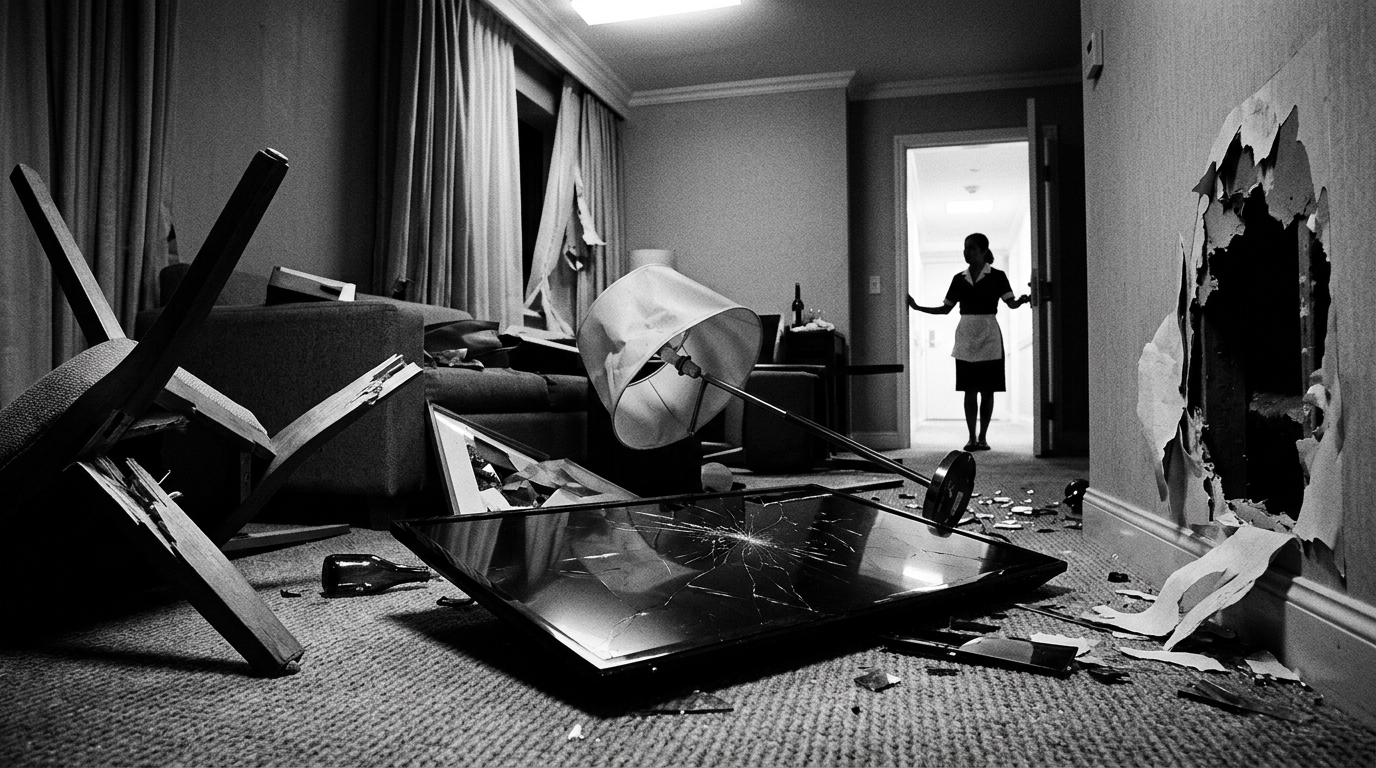
So here's what actually happened. A 26-year-old country artist shows up to perform at a resort casino in New Mexico, allegedly gets so intoxicated during soundcheck that he's stumbling, throwing microphones, knocking over a drum kit. Cancels the show. Goes back to his room. Staff eventually has to call law enforcement to escort him off property. And when housekeeping opens that door the next morning... TV destroyed, phone smashed, coffee table wrecked, two chairs broken (two more missing entirely), hole in the wall, additional wall damage, carpet stains. $16,000. Plus $400 in alcohol charged to the room and never settled.
Let me ask you something. What would have happened at YOUR property?
I consulted with a hotel group last year that had a similar situation... not a celebrity, just a wedding guest who did about $8,000 in damage to a suite. They had a credit card authorization for incidentals capped at $250. The guest disputed the damage charge. The card company sided with the guest pending investigation. The hotel spent four months in back-and-forth and recovered about 60% of the actual cost. The GM told me "we basically have no real protection against someone who decides to destroy a room." And he's not wrong. Most properties authorize $50-$150 for incidentals. Your damage deposit (if you even collect one) is maybe $250-$500. That covers a stained duvet cover, not a demolished suite.
Look, the celebrity angle makes this a headline. But the operational reality underneath it applies to every hotel running today. Your PMS probably has a damage workflow buried somewhere in a dropdown menu nobody's ever clicked. Your front desk team has never been trained on what to do when damage exceeds the authorization on file. Your night auditor (if you still have one) has zero protocol for documenting destruction in real-time before evidence gets compromised. And your insurance deductible on a property damage claim is probably $5,000-$10,000, which means anything under that threshold is just... your problem. The industry data suggests guest-caused property damage accounts for roughly 15% of hotel liability claims, and a typical hotel absorbs over $250,000 annually in damage-related costs. That's not a line item most operators are actively managing. It's a cost they're passively accepting.
The technology piece here is actually interesting (and by interesting I mean it barely exists). There are IoT-based room monitoring solutions that can detect anomalous noise levels, door activity patterns, unauthorized occupancy... systems that could theoretically alert security when someone is actively destroying a room at 1 AM instead of discovering it at 10 AM when housekeeping walks in. But most of these products are designed for party detection and unauthorized guest monitoring, not active damage prevention. And the ones that DO exist fail my basic evaluation test... what happens when the system alerts at 2 AM and there's one person on shift who's also covering the front desk? The alert is only as useful as the response protocol behind it, and most properties don't have one. The sensor tells you the room is being destroyed. It doesn't stop the destruction. It doesn't document it for your insurance claim. It doesn't authorize a higher hold on the guest's card. It just... beeps. At someone who can't do anything about it.
The warrant in this case wasn't signed until three weeks after the incident. Three weeks. The artist posted on social media that he "wasn't feeling well" and moved on. The hotel had to pursue criminal charges through tribal police jurisdiction. For most hotels without a casino's security infrastructure and law enforcement resources, the recovery path is even harder. You're filing a police report with local PD, submitting an insurance claim that might not clear your deductible, and disputing a credit card chargeback with a processor that defaults to the cardholder. The system is not built to protect the property owner in this scenario. It's built to make recovery so painful that most operators just eat the loss and move on.
Here's what to do this week. Pull up your incidental authorization policy and ask yourself what happens if a guest does $10,000 in damage tonight. If the answer involves the phrase "we'd figure it out," that's not a policy... that's a prayer. Talk to your front office manager about tiered authorization holds for suites and premium rooms. Document your damage assessment protocol in writing... who photographs, who catalogs, who contacts the guest, who files with insurance. If you're hosting entertainment or event talent, negotiate a separate damage deposit or bond through the promoter's contract before the artist ever gets a key card. And if you're running a property with 100+ rooms and you don't have a clear, trained, written protocol for damage exceeding $5,000... you're leaving money on the floor. This is what I call the Invisible P&L. The costs that never show up on your financial statements... the unrecovered damages, the rooms out of service, the staff hours spent chasing reimbursement... those are destroying more margin than the line items you're actually managing.