Charlotte's 200-Room Office Conversion Is a 5.8 Cap Rate Bet. At Best.
A New York developer wants to carve 200 hotel rooms and 399 apartments out of a 52-year-old Charlotte office tower with 25% vacancy. The per-key math on the hotel component tells you exactly how much faith they're putting in a market already absorbing 900 new rooms this year.
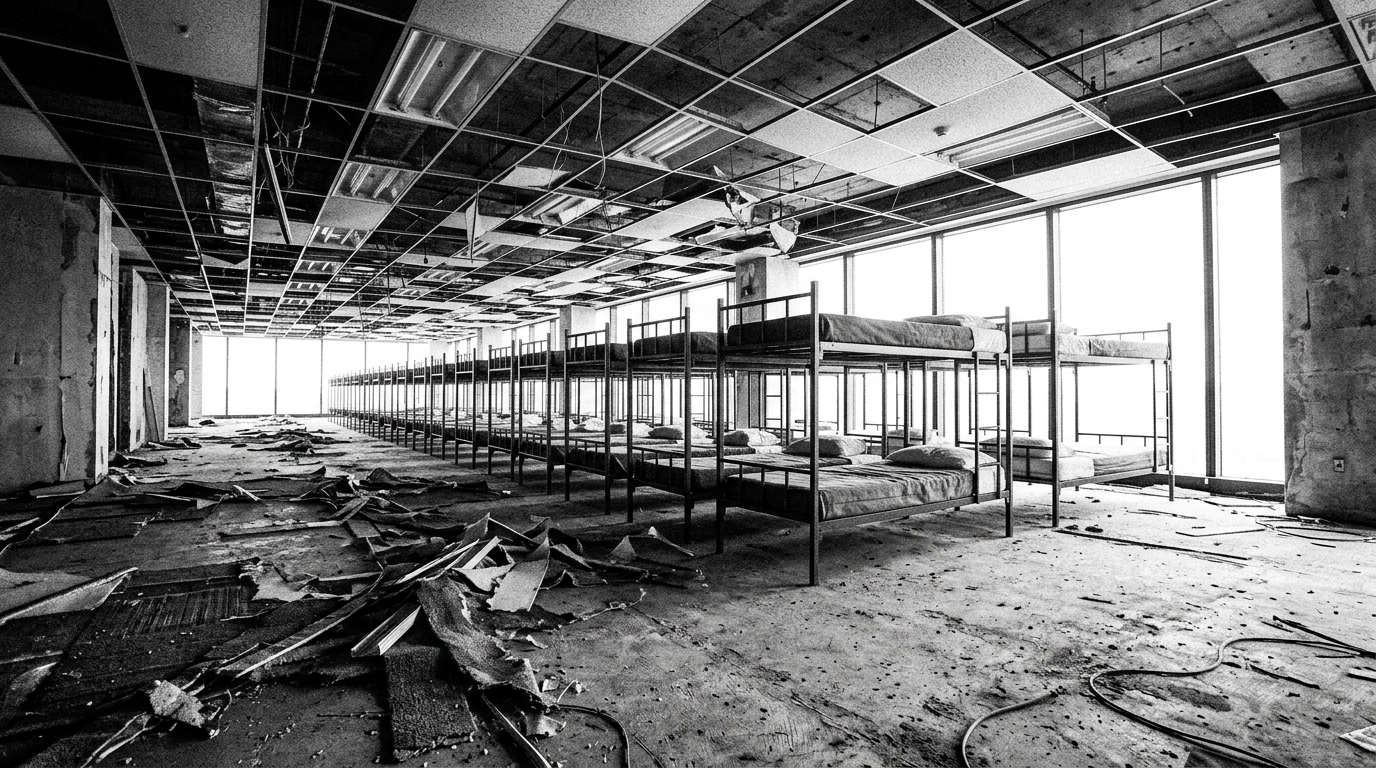
Charlotte's CBD office vacancy hit 25.6% in Q1 2025. A 32-story tower built in 1974 at 400 S. Tryon St. is now filed for conversion into 399 apartments and 200 hotel rooms with 24,000 square feet of retail. The developer is a New York-based firm. No acquisition price disclosed, no hotel flag announced, no construction budget published. That's a lot of unknowns for a project carrying two separate operating models inside a 52-year-old structure.
Let's decompose what's available. Charlotte's hotel market ran a $126 ADR and 65.9% occupancy through August 2024, producing $83 RevPAR. On 200 keys, that's roughly $6.1M in annual rooms revenue before you account for ramp-up (and a conversion from office space will ramp slowly... there's no installed guest base, no loyalty pipeline, no reservation history). Office-to-hotel conversion costs regularly exceed $300 per square foot in comparable markets. Even a conservative estimate on 200 keys puts the hotel component's development cost somewhere north of $40M, likely higher given the structural work required to retrofit 1974-era floor plates into viable guest rooms. That implies a per-key investment above $200K in a market where trailing RevPAR is $83. The stabilized yield math is thin.
The residential component is doing the heavy lifting here. Charlotte added 6% to its apartment inventory over the past year, and occupancy dipped to 91.7%. The 399 units are entering a market that's already absorbing significant new supply. But the developer's real calculus is probably simpler than a hotel analyst would like: the residential side pencils well enough to subsidize the hotel component, which provides a mixed-use zoning play, a ground-floor activation strategy, and (eventually) a stabilized income stream with a different demand curve than multifamily. The hotel is the loss leader in this capital stack.
Charlotte ranks ninth nationally for hotel conversion activity by project volume... 17 projects, 1,758 rooms. That's before counting the 245-room boutique conversion already approved three blocks away on S. Tryon. The market absorbed its highest annual opening since 2017 in 2024 with over 900 new rooms. Another 200 keys from an office conversion (with no disclosed brand affiliation and no established demand generator) will add supply into a market where RevPAR growth is running 3%. That 3% growth has to absorb the new inventory or ADR compresses. Probably both happen... occupancy softens during ramp-up, and rate pressure follows.
The structural question nobody's asking: who operates the hotel? A 200-key unbranded property inside a converted office tower competes for a very specific demand segment. Without a flag, there's no loyalty contribution (Charlotte's branded properties pull 30-40% from loyalty channels). Without loyalty, you're dependent on OTAs and local negotiated rate, which means higher cost of acquisition and lower net ADR. A management company will want 3-4% of gross revenue plus incentive fees. The residential management company will want its own fee structure on the 399 units. Two fee stacks, one building, one capital partner hoping both sides stabilize simultaneously. I've analyzed this exact structure at three different mixed-use conversions. The hotel component underperforms the pro forma in year one through three at every single one.
If you're running a hotel anywhere near Uptown Charlotte, here's your move. Pull your forward-looking comp set data and model what 200 incremental keys does to your rate positioning over the next 18-24 months. Don't wait for this to open... start the conversation with your revenue management team now. This is what I call the Three-Mile Radius. Your revenue ceiling just got a little lower, and the time to adjust your strategy is before the new supply shows up on the OTA search page, not after. For owners evaluating mixed-use conversion deals like this one... run your hotel component as a standalone investment. If it doesn't pencil without the residential subsidy, you're not building a hotel. You're building a cost center with a lobby.