An Airbnb Guest Said "We Paid Cleaning Fees" and Trashed the Place. Hotels Win This Argument Every Time.
An Airbnb host in India went viral after guests destroyed her property and justified it by saying they'd paid the cleaning charge. The incident exposes a structural flaw in short-term rentals that hotels solved decades ago... and most hotel operators aren't using it as the selling point it actually is.
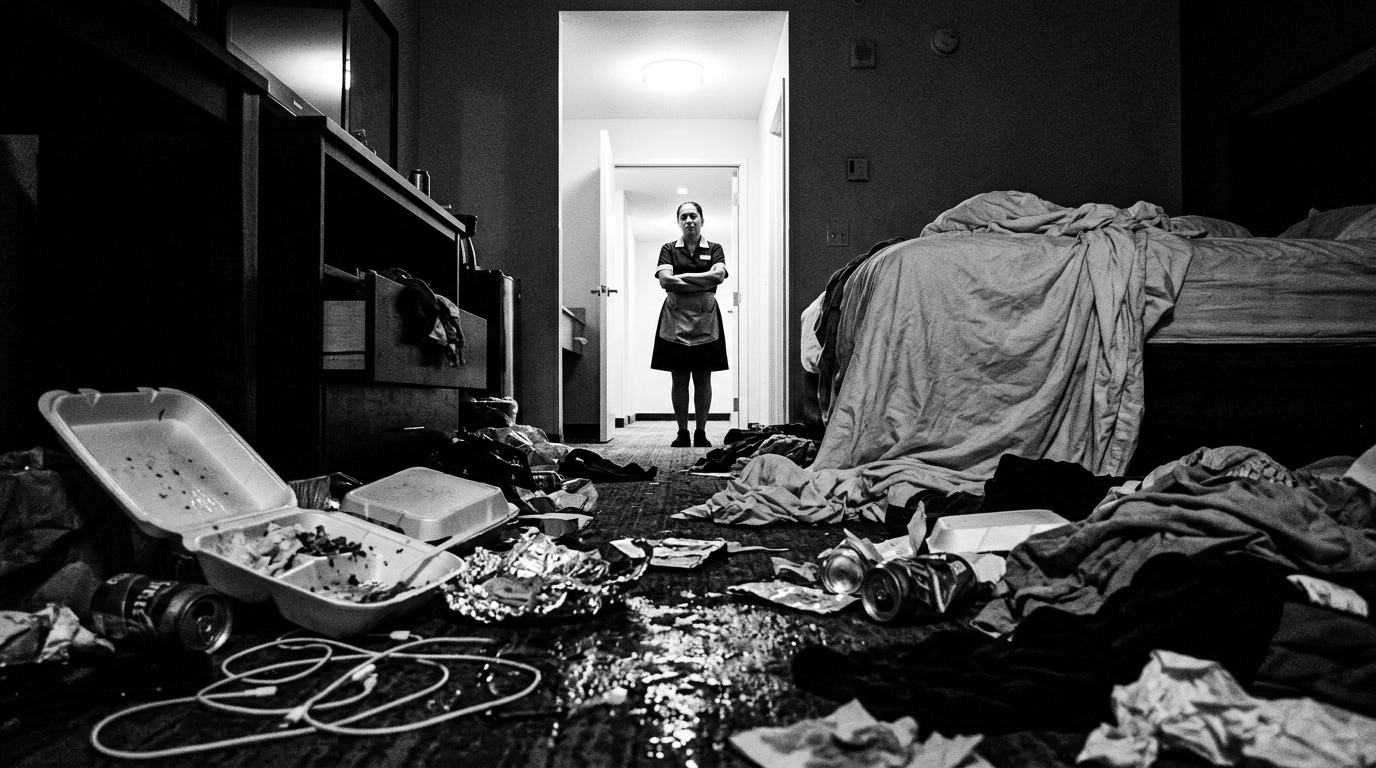
So here's what happened. An Airbnb host in India posted video of her rental property after guests checked out. Half-eaten food on the floor. Spills on the walls. A smell so bad that two cleaning staff flat-out refused to touch it. When the host confronted the guests, their response was basically: "We paid the cleaning fee. What's the problem?"
Two cleaning staff members walked away from the job. Let that sit for a second. The people whose literal job it is to clean... looked at the aftermath and said no. And the guests felt completely justified because they'd paid what averages out to about $160 per stay in the U.S. (up 27% since 2020, by the way). That's the fundamental misunderstanding baked into the short-term rental model. The cleaning fee was never designed to cover "we turned your apartment into a frat house." It's supposed to handle standard turnover... linens, vacuuming, restocking. But there's no mechanism to enforce that distinction. No staff on-site to manage the stay in real time. No accountability loop until the damage is already done. The host herself said something that should be on a billboard for every hotel sales team in America: "I feel like I'm running a hotel, not an Airbnb." Yeah. Exactly. And she's saying it like it's a bad thing... but for anyone in this industry, that sentence is the entire competitive advantage articulated in one frustrated quote.
Look, I've consulted with independent hotel groups that obsess over their tech stack, their distribution strategy, their OTA rankings... and completely ignore the fact that they have something Airbnb structurally cannot offer: real-time quality control. A housekeeper inspects every room before a guest walks in. A front desk agent is there at 2 AM if something goes wrong. A maintenance tech can respond to a broken AC unit in 20 minutes, not 48 hours after an app notification. That's not a legacy model... that's an operational architecture that prevents exactly what happened in this video. Nearly 30% of Airbnb complaints revolve around cleanliness or cleaning fees. That's not a bug. That's a design flaw in a platform that outsources quality assurance to strangers.
The technology angle here is what interests me most, because it's actually where Airbnb is weakest and where hotels keep underselling themselves. Airbnb's "quality control" is a review system... retroactive, gameable, and completely useless for the guest who just walked into a filthy unit. Hotels have real-time inspection workflows, housekeeping management systems, and (if they're using them properly) IoT sensors that flag maintenance issues before a guest even notices. The problem? Most properties treat these systems as back-office tools instead of marketing differentiators. I talked to a revenue manager last month who told me their property's cleanliness scores were consistently 15-20% higher than comparable Airbnbs in their comp set... and none of that data appeared anywhere in their booking funnel. Fifteen to twenty percent. That's not a marginal edge. That's a structural advantage being left on the table.
Here's what this incident actually is: free ammunition. Every time one of these videos goes viral (and they go viral roughly every few months now... there was a nearly identical incident in Goa in late 2024), it reinforces a narrative that benefits hotels. But only if hotels actually claim the narrative. The cleaning fee debate, the inconsistent quality, the zero accountability during the stay... these aren't Airbnb problems that will get fixed with better algorithms. They're architectural limitations of a model that puts a platform between the guest and the experience with no operational layer in between. Hotels ARE the operational layer. That's the product. Start selling it like one.
Here's what to do with this, and I'm talking specifically to GMs and directors of sales at properties competing with Airbnb in your market. Pull your cleanliness and maintenance scores from the last 90 days. Compare them to the Airbnb listings in your three-mile radius (check the reviews... the data is public). If you're winning that comparison... and you probably are... that needs to be in your direct booking messaging this week. Not buried in a FAQ. Front and center. "Professionally cleaned. Inspected before every arrival. Staff on-site 24/7." That's not a feature list. That's a direct response to the anxiety every traveler who's seen one of these viral videos now carries. The cleaning fee transparency issue alone is a gift... your rate is your rate. No hidden $160 surprise at checkout. Use it.